 647-740-8602
 info@ontarioliftrepair.ca

About Us
We denounce with righteous indignation and dislike men who we are to beguiled demoralized by the charms of pleasures that moment, so we blinded desires, that they indignations.
Conatct Us
54B, Tailstoi Town 5238 MT,
La city, IA 522364


54B, Tailstoi Town 5238 MT,
La city, IA 522364
The world’s most productive Material handling and warehouses have the workhorse known as forklifts. Nevertheless, the choices that should be considered vital, in choosing the appropriate forklift, is the choice between an electric forklift and a diesel forklift.
All these types have their advantages and drawbacks, and knowing about the principal differences between these two types, businesses might discover the most economically effective, environmentally friendly, and reasonable choice in terms of their activity.
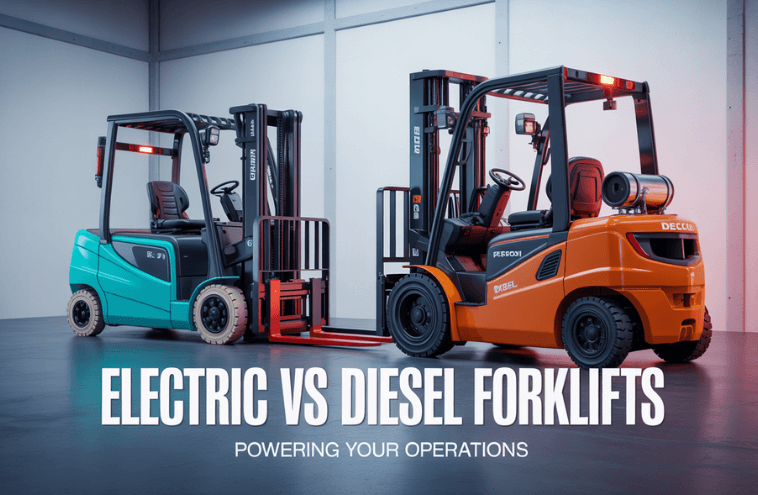
This blog outlines the key comparisons between Electric and Diesel Forklifts regarding performance, cost, environmental friendliness, maintenance, usage, and suitability at the workplace.
The power source of the two types of forklifts forms the most evident difference between them- electric and diesel.
In a short-term forklift rental, electric forklifts run on large rechargeable industrial batteries that typically last 5 to 8 hours on a single charge, depending on the workload and battery capacity. They operate silently and do not emit fumes.
Conversely, diesel forklifts operate on conventional internal combustion engines that use diesel fuel. They are empowered with high torque and power, and thus, they are used in heavy-duty tasks and outdoors.
Although electric forklifts can be charged at a charging station as plug and play, diesel forklifts must be refueled, which in high-demand operations can be faster than charging but introduces the overhead of fuel expenses over time.
Diesel forklifts normally win when it comes to raw power and performance. They are built to take on rough, harsh work, like lugging heavy materials around or working on an uneven surface, and as such would be well at home on a construction site, in a port, or in an outdoor yard.
With lower power, even so, electric forklifts can still lift impressive weights, usually up to 5,0006,000 kg, depending on the model. They, however, may experience a slight decline in performance as the battery discharges. This gap is gradually being reduced with the improvement in lithium-ion battery technology.
IC engines are more complex and need more frequent maintenance than diesel forklifts. Routine maintenance includes oil changes, air filter replacement, exhaust system maintenance, and engine tune-ups. In the long run, it increases maintenance expenses and downtime.
In comparison, electric forklifts have fewer moving parts, and therefore less routine maintenance is required. No engine oils, transmissions, or fuel systems to concern me with. Maintenance is mainly concerned with battery care – ensuring that the charging cycles are correct, adding water (in the case of lead-acid batteries), and a general check-up.
Forklift Rental Service can provide greater long-term maintenance and energy cost savings, even when the upfront purchase price is considered as part of the total cost of ownership.
The sustainability race has clear winners, which are electric forklifts. They produce no emissions at the point of use and are quiet in operation, which makes the working environment healthier and safer. Electric models are more suitable in terms of corporate social responsibility objectives in the case of businesses that seek to gain green certifications or reduce their carbon footprint.
Diesel forklifts, alas, produce carbon monoxide, nitrogen oxides, and particulates, so they are not the best choice in enclosed or poorly ventilated areas. Newer diesel models may be able to adhere to much more stringent emission standards, but they remain less environmentally friendly than electric forklifts.
The area of use of the forklift also determines your decision.
Indoor places such as warehouses, shops, and food storage places are best suited to electric forklifts. Their emissions-free operation and quiet running nature make them applicable in confined areas where air quality is critical.
Outside operations are better with diesel forklifts. They are resistant to rain, dirt, and irregular surfaces and can work longer without requiring recharging. They can also tug or lift heavier resources, particularly in the construction or production areas.
Cost, diesel forklifts tend to be cheaper to purchase than electric ones. But in the long run, the price of diesel fuel, maintenance, and environmental compliance may make the diesel models more expensive to run.
Electric forklifts have high initial costs, particularly when you are establishing new battery charging facilities. However, in the long run, they are likely to reduce operating expenses, particularly where electricity is relatively cheaper than diesel in your location.
To simplify it:
Noise is another factor in forklift operations that is usually ignored yet it may affect the productivity and safety of the workers.
Electric forklifts are also very quiet and hence minimize noise pollution within facilities. This makes the work environment more enjoyable and stress-free, particularly during long shifts. The low noise level also contributes to better communication between the workers.
The combustion engines in diesel forklifts make a lot of noise. This can be a challenge in indoor or mixed environments, but in outdoor operations, it may not matter much.
Also, electric forklifts have a milder acceleration and deceleration, which enhances better handling and safety.
Electric forklifts must have their battery well managed. It takes several hours to charge (unless you have a fast charger), and batteries have to be allowed to cool after charging. This may be a logistical problem in multi-shift work unless spare batteries or battery swapping stations are provided.
Choosing which type of forklift, electric or diesel, is mostly based on your business model, operating conditions, cost, and sustainability aspirations.
In the end, Electric vs Diesel Forklifts can be useful in the material handling sector. So popular are the electric forklifts that many firms today operate a mixed fleet, with the electric trucks working inside the warehouse and the diesel-powered models outside to take advantage of the superiority of each. The trick to making the correct investment is to understand your particular needs.
Also Read: Common Forklift Problems and How to Troubleshoot Them


Leave A Comment